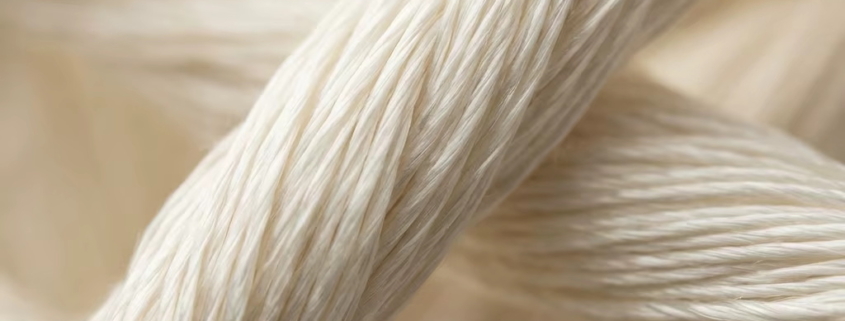
cotton modal yarn

1. Introduction

Modal yarn is a regenerated cellulose fiber spun from beechwood pulp — semi-synthetic, plant-based, and engineered to outperform standard viscose rayon in every dimension that matters on a production line: wet strength, dimensional stability, and dye consistency. For textile manufacturers and garment factories, modal occupies a strategic middle ground: softer and more absorbent than cotton, stronger and more stable than viscose, and less expensive than lyocell.

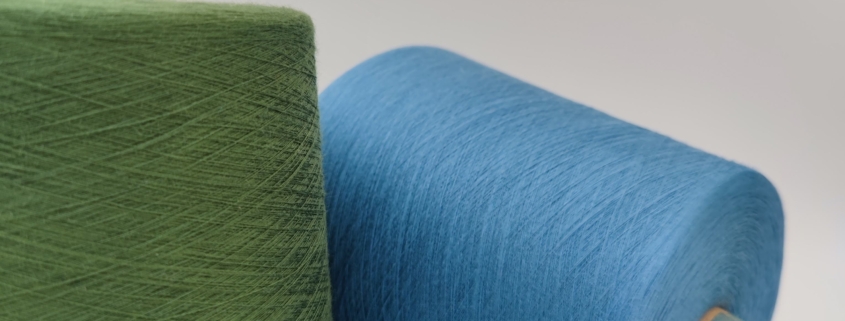
At YarnMFG, we produce modal and cotton-modal blended yarns across a range of counts and ratios for applications from underwear and t-shirts to premium knitwear and home textiles. This guide covers what buyers need to know — beyond the consumer-facing talking points — to make informed procurement decisions.

2. How Modal Yarn is Made

Modal begins as beechwood chips, predominantly sourced from sustainably managed European forests. The chips are dissolved into a pulp, then extruded through a spinneret into fibers using a solvent-spinning process. Unlike conventional viscose production, which generates significant carbon disulfide emissions, modal manufacturing uses a closed-loop system that recovers and reuses approximately 95% of the spinning solvent.

The result is a fiber with a smooth surface, circular cross-section, and higher wet tenacity than viscose — because modal undergoes a modified coagulation bath and higher stretching during production, which aligns the cellulose chains more effectively. The dominant global supplier is Lenzing AG (Austria), which markets modal under the TENCEL™ Modal brand. Non-Lenzing modal exists but typically lacks the same quality consistency and certification traceability.

Modal is also available in finer denier variants:

  • Standard modal — 1.3–1.7 dtex, used in most apparel yarns
  • MicroModal® — 0.9–1.0 dtex, for ultra-lightweight luxury knits and intimate apparel
  • MicroModal® Air — below 0.9 dtex, the finest variant for premium next-to-skin garments

3. Modal vs Viscose vs Lyocell: The Key Differences

Modal belongs to the regenerated cellulose family alongside viscose and lyocell. All three start from wood pulp, but their production processes and resulting fiber properties differ substantially — and those differences directly affect spinnability, fabric performance, and price.

Property

Viscose

Modal

Lyocell

Why It Matters

Dry Tenacity (cN/tex)

15–25

23–30

34–40

Modal offers ~40% higher dry strength than viscose at marginally higher cost

Wet Tenacity (cN/tex)

7–12

18–25

28–34

Modal’s 2× wet strength over viscose enables machine washing without fiber collapse

Production

Open process, CS₂ emissions

Closed-loop, ~95% solvent recovery

Closed-loop, >99% solvent recovery

Modal’s environmental profile is significantly cleaner than viscose

Moisture Regain (%)

11–13

11–13

11–13

All three absorb moisture similarly; modal’s advantage is strength when wet

Price Tier

$

$$

$$$

Modal sits 20–40% above viscose, 15–25% below lyocell

Practical takeaway: choose viscose when cost dominates; choose lyocell when maximum wet durability and eco-credentials are non-negotiable; choose modal when softness, strength when wet, and mid-range pricing align with your product positioning.

4. Modal Yarn Properties: The Data Buyers Need

The table below compiles the quantitative properties that matter for yarn procurement — the same metrics you should request on a supplier’s specification sheet before placing a purchase order.

Property

Modal (1.3 dtex)

Manufacturing Relevance

Dry Tenacity (cN/tex)

23–30

Sets upper limit for yarn count and machine tension

Wet Tenacity (cN/tex)

18–25

Determines wash durability; modal retains ~70–80% strength wet vs viscose’s 40–50%

Elongation at Break (%)

12–18

Sufficient elongation for knitting; avoids brittle breaks on high-speed circular machines

Moisture Regain (%)

11–13

~50% higher than cotton (7–8.5%); supports cooling and comfort in finished garments

Density (g/cm³)

1.52

Slightly lower than cotton (1.54); fabric weight calculations adjust accordingly

Dimensional Stability

Low shrinkage (<3% at 40°C)

Fewer customer returns due to garment distortion after washing

Pilling Resistance

Good — better than cotton

Smooth fiber surface plus adequate wet strength reduces surface fuzz generation

Modal yarn takes reactive dyes well, producing bright colors with good wash fastness. However, because its surface is smoother than cotton’s, dye penetration is slightly different — experienced dyehouses adjust their salt-alkali profile to compensate. Request lab dips from each new lot. Modal’s batch-to-batch color consistency is generally better than viscose but still warrants testing before bulk runs.

5. Blend Engineering: Cotton-Modal Ratios That Work

Pure 100% modal yarn is technically spinnable but relatively uncommon in commercial production. Most modal enters the supply chain as a blend — the question is at what ratio, and for what purpose.

The table below shows the most widely produced modal blend specifications in the market:

Blend

Ratio

Typical Count (Ne)

Primary Application

Sample Available?

Cotton-Modal

60/40

16s–32s

T-shirts, underwear, loungewear — softness with cotton structure and lower cost

Yes

Cotton-Modal

50/50

21s–40s

Premium knitwear, polo shirts, lightweight tops — elevated drape and hand feel

Yes

Cotton-Modal

70/30

16s–32s

Entry-level modal blend — softer than 100% cotton, minimal cost uplift

Yes

Modal-Rich Blend

80/20 Modal-Cotton

30s–60s

Luxury intimate apparel, sleepwear — silk-like hand with cotton dimensional stability

Yes

Modal-Spandex

95/5

30s–50s

Activewear linings, body-hugging tops — modal softness plus spandex stretch recovery

Yes

Modal-Wool

50/50

24s–40s

Lightweight sweaters — wool warmth with modal drape and next-to-skin comfort

On request

Why cotton-modal blends dominate: Cotton provides the structural backbone and keeps the per-kg cost manageable; modal provides the softness, drape, and moisture management that differentiate the finished garment. The 60/40 cotton-modal ratio (YarnMFG’s most popular stock item) hits the sweet spot — a clear sensory upgrade from 100% cotton without doubling the yarn bill.

6. Applications by Yarn Count

Modal’s smooth surface and consistent staple length make it highly spinnable on ring frames from Ne 16s up to Ne 60s. Open-end spinning is possible for coarser counts (Ne 10s–16s) but less common because modal’s value proposition — softness and drape — is best realized in ring-spun quality.

Count Range

Typical Fiber/Blend

Primary Applications

Key Selling Point

Ne 10s–16s

Modal-cotton blends, modal-rich OE yarns

Towels, bathrobes, home textiles

Higher absorbency than 100% cotton terry

Ne 16s–24s

60/40 or 50/50 cotton-modal

T-shirts, tank tops, underwear, casual knitwear

Noticeably softer than 100% cotton; retail price premium justifies the BOM cost

Ne 24s–32s

50/50 cotton-modal, 80/20 modal-cotton

Premium polo shirts, dresses, lightweight blouses

Fluid drape, low shrinkage, color brilliance

Ne 32s–60s

Modal-rich blends, modal-spandex 95/5, MicroModal®

Luxury intimate apparel, sleepwear, premium linings

Silk-like hand at a fraction of silk’s cost; compatible with fine-gauge knitting

7. Certifications & Procurement Checklist

For modal yarn entering regulated markets, three certifications carry the most weight:

  • Lenzing certification — verifies that the modal fiber is genuine Lenzing TENCEL™ Modal, not generic or blended with viscose. This is the single most important certification for brand-name modal.
  • OEKO-TEX Standard 100 — confirms the yarn is free from harmful substances. Mandatory for EU apparel and home textiles. YarnMFG holds this certification.
  • EU Ecolabel / FSC — attests to sustainable forestry practices for the beechwood source and low-impact manufacturing. Increasingly required by European brand sustainability programs.

Before issuing a purchase order for modal yarn, run through this five-point checklist:

  1. Verify fiber origin— is it Lenzing TENCEL™ Modal? Request the certificate.
  2. Request tenacity and CVm% test reports— target CVm ≤ 13% for counts Ne 24+.
  3. Confirm count, twist level (TPM), and blend ratio— write these into the PO, not just the email.
  4. Check certification documentation— scope certificate PDF, not just a certificate number.
  5. Sample before bulk— modal’s smooth surface can cause minor dye uptake differences between production lots. Run at least two lab-dip confirmations from separate production batches.

8. Modal vs Cotton: Head-to-Head for Apparel Buyers

Modal is frequently positioned as a premium upgrade to cotton in the same product categories. Here is how they compare on the metrics buyers care about:

Criterion

100% Cotton

Cotton-Modal Blend (60/40)

Hand Feel

Soft, natural, slightly crisp

Noticeably softer, silk-like

Moisture Absorption

7–8.5% regain

~50% higher absorption

Dye Brilliance

Good with reactive dyes

Superior color depth and luster

Shrinkage

3–5% typical

<3% at 40°C

Pilling Resistance

Moderate

Better — fewer surface fibers

Cost per kg

$ (baseline)

15–30% premium over 100% cotton

Best For

Mass-market basics, workwear

Mid-to-premium apparel where softness sells

The takeaway: if your customer is selling a £12 t-shirt, 100% cotton is the right fiber. If they are selling a £25+“supersoft” t-shirt, a 60/40 or 50/50 cotton-modal blend gives them a verifiable material story to justify the price point.

9. Frequently Asked Questions

Q: Is modal yarn eco-friendly?

Modal is more environmentally responsible than conventional viscose because of its closed-loop solvent recovery (~95%) and reliance on beechwood — a fast-growing, low-water-demand tree species typically sourced from FSC-certified European forests. However, the fiber is still chemically processed and not biodegradable in the same way untreated cotton is. For maximum eco-credentials, lyocell (TENCEL™) with >99% solvent recovery is the stronger choice, but modal offers a meaningful environmental improvement over standard viscose at a lower cost than lyocell.

Q: How does modal compare to cotton for t-shirts?

Modal-blend t-shirts feel softer, drape better, and absorb moisture faster than 100% cotton equivalents. They also shrink less and resist pilling longer. The trade-off is a 15–30% higher yarn cost. For brands where “softest t-shirt you’ll ever wear” is a selling point, the cost delta is easily absorbed. For budget basics, cotton remains the standard.

Q: Can modal yarn be used for activewear?

Modal alone lacks the stretch recovery needed for high-performance activewear. However, a 95/5 modal-spandex blend works well for yoga tops, studio wear, and activewear linings where softness and breathability matter more than maximum elasticity. For high-compression sportswear (leggings, sports bras), polyester-spandex or nylon-spandex remains the better choice.

Q: What is the difference between modal and MicroModal?

MicroModal® is a finer-denier variant (0.9–1.0 dtex vs standard modal’s 1.3–1.7 dtex). The finer individual fibers produce an even softer, lighter fabric — typically used in luxury intimate apparel and ultra-lightweight knits at Ne 40s and above. MicroModal® Air (<0.9 dtex) is the finest grade available. Both are Lenzing trademarks and carry the same OEKO-TEX certification compatibility as standard modal.

Q: Does modal yarn shrink?

Modal has better dimensional stability than cotton. Expect <3% shrinkage at a 40°C wash cycle vs cotton’s typical 3–5%. That said, any cellulosic fiber will shrink somewhat on first wash — pre-shrinking the fabric (compacting/mercerizing) before cutting eliminates most of this risk at the garment level.

10. Conclusion

Modal yarn occupies a strategic position in the textile fiber landscape: softer and more stable than cotton, stronger and cleaner than viscose, more affordable than lyocell. For manufacturers producing mid-to-premium knitwear, underwear, loungewear, and home textiles, a cotton-modal blend — particularly 60/40 or 50/50 — delivers a verifiable product upgrade at a manageable cost increment.

YarnMFG produces modal and cotton-modal blended yarns from Ne 10s to Ne 60s, including our most popular stock items: 60/40 combed cotton-modal in Ne 21s and Ne 32s, with OEKO-TEX Standard 100 certification and third-party testing documentation (SGS, ITS, BV) provided with every shipment.

To request specification sheets, lab-dip samples, or certification documentation, contact our yarn specialists or browse our modal and blended yarn product catalog.

Disclaimer: Modal is a registered trademark of Lenzing AG in many jurisdictions. TENCEL™, MicroModal®, and MicroModal® Air are trademarks of Lenzing AG. Fiber property values are typical ranges; actual values vary by supplier, yarn count, and processing conditions. Certifications referenced are current as of July 2026.
recycle cotton

1. Introduction

Every yarn procurement decision starts with one question: which fiber? The answer determines not just the yarn’s price, but its spinnable count, tensile strength, dyeing behavior, environmental footprint, and regulatory compliance pathway. For textile manufacturers, fabric mills, and garment factories ordering by the ton rather than the skein, choosing the wrong fiber is not an inconvenience — it is a production-line liability.

This guide covers the full spectrum of yarn fibers from a B2B procurement perspective. Unlike consumer-facing overviews that focus on hand feel and project suggestions, we emphasize the metrics that matter on the factory floor: tenacity, elongation, moisture regain, blend ratios, spinning compatibility, and certification requirements. We focus in particular on the fibers we manufacture at YarnMFG — recycled polyester, cotton, organic cotton, recycled cotton-polyester blends, Tencel/Lyocell, modal, and TC/CVC blended yarns — while providing concise industry-reference coverage of animal and bast fibers.

2. Fiber Classification at a Glance

Yarn fibers fall into five broad categories. Understanding the taxonomy helps purchasers quickly narrow options before diving into specifications.

Category

Source

Key Fibers (YarnMFG products in bold)

Natural — Animal

Sheep, goats, silkworms, rabbits

Wool, alpaca, cashmere, mohair, silk, angora (not produced by YarnMFG)

Natural — Plant

Seed, bast, leaf

Cotton, organic cotton, recycled cotton, linen, hemp

Regenerated Cellulose

Wood pulp / plant cellulose

Lyocell/Tencel, modal, viscose, cupro

Synthetic

Petrochemical polymers

Recycled polyester (rPET), virgin polyester staple, polyester DTY/FDY/POY, nylon, acrylic, spandex

Recycled

Post-consumer / pre-consumer waste

Recycled polyester (GRS), recycled cotton-polyester blends, recycled nylon

3. Cotton & Plant-Based Fibers

3.1 Virgin Cotton — The Workhorse of Textiles

Cotton accounts for roughly 25% of global fiber production. For yarn buyers, the key distinction is staple length. Upland cotton (22–32 mm) dominates the market and spins comfortably up to Ne 40 on ring frames. Pima and Egyptian long-staple cotton (33–38 mm) reach Ne 60–120 but command a significant premium.

Virgin cotton’s defining advantage is fiber length uniformity. With short fiber content below 8% and tenacity of 26–32 cN/tex, it produces yarns with low hairiness (H 3.5–4.5 on the Uster scale) and consistent dye uptake across production lots. It is fully biodegradable, hypoallergenic, and available in both conventional and organic grades.

  • Upland cotton: Ne 6–40, ring-spun, commodity-priced, global supply
  • Organic cotton: GOTS-certified options, same physical properties as conventional with full agricultural traceability
  • Recycled cotton: requires blending with virgin fiber (typically 20–50% recycled content); mechanically recycled fiber length drops to 10–22 mm — see our detailed comparison article

3.2 Bast Fibers — Industry Reference

Linen, hemp, jute, and ramie are bast fibers extracted from plant stems. They have high tenacity (linen: 45–55 cN/tex) but very low elongation (2–3%), making them stiff and wrinkle-prone. These are not part of YarnMFG’s production line, but they are relevant for buyers sourcing industrial textiles, ropes, and specialty fabrics.

4. Regenerated Cellulose Fibers

4.1 Lyocell / Tencel — The Premium Choice

Lyocell, best known under the brand name Tencel (Lenzing AG), is produced through a closed-loop solvent-spinning process that recovers over 99% of the NMMO solvent. Its wet tenacity (34–40 cN/tex) far exceeds viscose (15–25 cN/tex dry, dropping to 7–12 wet), making it the only regenerated cellulose fiber that rivals polyester in wet-state durability. It has a smooth surface that minimizes fibrillation, excellent moisture management (regain ~11%), and full biodegradability.

  • YarnMFG produces Lyocell yarns in counts from Ne 10s to Ne 40s
  • Common blends: Lyocell-cotton (50/50), Tencel-modal (for premium knitwear)

4.2 Modal — Softness at Scale

Modal is a beechwood-pulp fiber with higher wet strength than viscose and a softer hand feel. Our combed cotton-modal 60/40 yarn in Ne 21s and 32s is a stock item widely used for underwear, t-shirts, and loungewear. Modal blends improve drape and reduce the stiffness of 100% cotton knits without sacrificing breathability.

4.3 Viscose — The Budget Option

Standard viscose is the least expensive regenerated cellulose fiber but has significant trade-offs: tenacity drops 40–50% when wet, and conventional production involves carbon disulfide emissions. It remains popular for fast-fashion knits and blends where cost is the primary driver.

5. Polyester & Synthetic Fibers

5.1 Recycled Polyester (rPET) — YarnMFG’s Flagship

Recycled polyester staple fiber, produced from post-consumer PET bottles, is the fastest-growing segment in the industrial yarn market. At YarnMFG, we process over 50,000 tons of bottle flakes annually through a vertically integrated line: bottle washing → flake production → melt spinning → drawing → cutting into staple, then ring or open-end spinning into yarn from Ne 0.5s to Ne 32s.

rPET delivers a tenacity of 35–50 cN/tex (comparable to virgin polyester), with the sustainability advantage of approximately 59% lower CO₂ emissions compared to virgin PET. It is inherently hydrophobic (moisture regain 0.4%), resistant to mildew and bacteria, and fully recyclable — making it the preferred choice for socks, gloves, mops, hammocks, denim weft, curtain fabrics, pet toys, and industrial wipes.

  • GRS-certified (Global Recycled Standard) — full chain-of-custody documentation available
  • Available as ring-spun or open-end yarn in Ne 0.5s–32s
  • Also available as filament: recycled polyester DTY, FDY, and POY for weaving and knitting

5.2 Virgin Polyester Staple & Filament

Virgin polyester remains the world’s most produced synthetic fiber for a reason: it is inexpensive, strong (tenacity 35–70 cN/tex depending on draw ratio), and versatile. YarnMFG supplies virgin polyester spun yarn (ring and open-end) for applications where recycled content is not required, as well as DTY (draw-textured yarn for stretch and bulk), FDY (fully drawn yarn for high-tenacity weaving), and POY (partially oriented yarn for post-processing).

5.3 Nylon, Acrylic & Spandex — Industry Reference

Nylon (polyamide) offers the highest tenacity of commodity synthetic fibers (40–85 cN/tex) and excellent abrasion resistance, making it essential for socks, workwear, and industrial fabrics. Acrylic is a wool substitute with good thermal insulation but poor moisture absorption. Spandex/elastane is never used alone — even 2–5% in a cotton or polyester yarn dramatically improves stretch recovery. These fibers are not part of YarnMFG’s production line but are critical context for buyers building multi-fiber supply chains.

6. Animal Fibers — Industry Reference

Animal fibers are not produced by YarnMFG, but every yarn buyer should understand their properties for competitive context.

Fiber

Micron Range

Key Trait

Typical Use

Price Tier

Wool (Merino)

18–24 µm

Elastic, insulating, felts

Sweaters, socks, suiting

$$$

Cashmere

14–19 µm

Ultra-soft, lightweight

Luxury knitwear

$$$$

Alpaca

18–35 µm

Warm, low memory

Outerwear, accessories

$$$

Silk

10–13 µm

Strongest natural fiber

Luxury blends, linings

$$$$

7. Fiber Property Comparison

The table below compares key quantitative properties across the fibers most relevant to industrial yarn procurement.

Fiber

Tenacity (cN/tex)

Elongation (%)

Moisture Regain (%)

Density (g/cm³)

Melting / Decomp. (°C)

Price Tier

rPET

35–50

15–55

0.4

1.38

250–260

$

Polyester Staple

35–70

15–55

0.4

1.38

250–260

$

Cotton (Upland)

26–32

6–9

7–8.5

1.54

Decomposes

$$

Lyocell/Tencel

34–40

10–15

11–13

1.52

Decomposes

$$

Modal

23–30

12–18

11–13

1.52

Decomposes

$$

Recycled Cotton

14–22

3–5

7–8.5

1.54

Decomposes

$–$$

Wool (Merino)

9–15

25–35

14–16

1.31

Decomposes

$$$

Nylon 6

40–85

20–45

4.5

1.14

215–220

$$

Viscose

15–25

15–30

11–13

1.52

Decomposes

$

Note: YarnMFG-produced fibers are shown in bold. Values are typical ranges; actual specifications vary by supplier, yarn count, and processing method.

8. Blend Ratios That Work in Production

Most industrial yarns are blends. The right ratio balances cost, performance, and processability. Below are the standard formulations that YarnMFG produces regularly, tested across thousands of tons of output.

Blend

Ratio

Typical Application

Why It Works

Polyester-Cotton (TC)

65/35

Workwear, uniforms

Polyester adds strength & wrinkle resistance; cotton provides comfort & breathability

Cotton-Polyester (CVC)

60/40

T-shirts, casual knits

Cotton-dominant face for hand feel; polyester core for durability

Cotton-Modal

60/40 or 50/50

Underwear, loungewear

Modal adds drape and softness; cotton maintains structure and reduces cost

rPET-Cotton

50/50 to 65/35

Sustainable basics

GRS-certified recycled content with cotton comfort; strong sustainability narrative

Recycled Cotton-Polyester

30/70 to 50/50

Denim weft, mops, wipes

Recycled cotton diverts textile waste; polyester carrier enables spinning; coarse counts (Ne 6–16)

Lyocell-Cotton

50/50

Premium shirting, dresses

Lyocell elevates hand feel and drape; cotton anchors affordability and processability

9. Spinning Compatibility & Yarn Counts

Not every fiber works with every spinning system. YarnMFG’s production spans Ne 0.5s to Ne 32s using both ring and open-end frames, but the count ceiling varies sharply by fiber type.

Fiber

Ring-Spun Range (Ne)

Open-End Range (Ne)

Recycled Polyester (rPET)

Ne 20s–32s

Ne 0.5s–21s

100% Cotton

Ne 10s–40s

Ne 6s–20s

TC/CVC Blends

Ne 10s–32s

Ne 6s–21s

Lyocell / Modal Blends

Ne 16s–40s

Ne 10s–20s

Recycled Cotton Blend

Ne 16s–21s

Ne 6s–16s

Key rule: ring spinning delivers higher quality, lower hairiness, and finer counts; open-end spinning tolerates shorter fibers, runs faster, and costs less per kg. For coarse industrial yarns (Ne 6–12) — mops, ropes, wipes — open-end is the standard choice. For apparel-grade yarns (Ne 20+), ring-spun quality is expected.

10. Certifications for Industrial Buyers

For yarn entering regulated markets (EU, US, Japan), certification is not optional. It is a prerequisite for customs clearance, brand compliance, and consumer trust. YarnMFG holds four key certifications that cover the most frequent buyer requirements:

  • OEKO-TEX Standard 100 — Verifies that every component of the yarn is free from harmful substances. Mandatory for EU apparel and home textiles.
  • GRS (Global Recycled Standard) — Certifies recycled content claims with full chain-of-custody through Transaction Certificates (TCs). Required for any product marketed as “recycled.”
  • GOTS (Global Organic Textile Standard) — Certifies organic fiber from farm to finished yarn. Required for products labeled “organic cotton.”
  • BCI (Better Cotton Initiative) — Verifies cotton sourced through a program that promotes improved farming practices. Widely recognized by global apparel brands.

Before issuing a PO, verify that your yarn supplier’s scope certificate is current, covers your specific fiber type, and lists the supplier as an active facility. A certificate number alone is not sufficient — request the full PDF.

11. Application Guide — Which Fiber for Which Job?

The matrix below maps YarnMFG’s core fibers to the most common industrial applications we serve.

Application

Recommended Fiber

Typical Count (Ne)

Key Reason

Sample Available?

Socks

rPET / Cotton blend

10s–21s

Durability + moisture control

Yes

Gloves

rPET or recycled blend

6s–16s

Abrasion resistance + low cost

Yes

Denim (weft)

Recycled cotton-polyester

6s–12s

Texture-tolerant, sustainable story

Yes

Towels

100% Cotton / Cotton-Modal

10s–21s

Absorbency + soft hand feel

Yes

Mops & Cleaning

rPET / Recycled blend

0.5s–10s

Lowest cost, hydrophobic, mildew-proof

Yes

Curtain Fabric

rPET DTY/FDY

75D–300D

Drape, UV resistance, colorfast

Yes

Pet Toys

rPET / Cotton blend

6s–16s

Non-toxic, durable, washable

Yes

T-shirts (premium)

Cotton-Modal / Lyocell blend

21s–32s

Softness + drape + dye consistency

Yes

12. Frequently Asked Questions

Q1: What is the strongest natural yarn fiber?

Silk is the strongest natural fiber (tenacity 30–45 cN/tex), but for industrial-scale yarn production, cotton offers the best balance of strength, processability, and cost. For applications where strength is paramount, synthetic fibers like recycled polyester (35–50 cN/tex) or nylon (40–85 cN/tex) outperform any natural fiber.

Q2: What is the difference between filament and staple yarn?

Filament yarns are made from continuous strands of fiber extruded to a specified denier and twisted or textured (e.g., DTY, FDY, POY). Staple yarns are spun from short fibers of a defined length (22–38 mm for cotton, 32–51 mm for polyester staple). Staple yarns have a softer, more natural hand and better moisture absorption; filament yarns offer higher tenacity, less pilling, and a smoother surface. YarnMFG supplies both types.

Q3: Which yarn fiber is best for socks?

For mass-market socks, a recycled polyester-cotton blend (50/50 or 65/35) in Ne 10s–21s provides the best combination of durability, moisture management, and cost. For premium socks, nylon-reinforced cotton or wool blends are common, though outside YarnMFG’s production scope.

Q4: How do I verify fiber content in a yarn shipment?

Request a fiber composition test report from an accredited third-party laboratory (SGS, Intertek, or Bureau Veritas). For recycled content claims, a valid GRS Transaction Certificate (TC) matching your lot number is the gold standard. YarnMFG provides both with every shipment.

Q5: What certifications do I need to export yarn to the EU?

OEKO-TEX Standard 100 is the baseline for chemical safety. For recycled content claims, GRS certification with full TC chain is required. For organic cotton, GOTS is mandatory. BCI is widely recognized by European apparel brands for conventional cotton. YarnMFG holds OEKO-TEX, GRS, GOTS, and BCI certifications — all current and scope-verified.

13. Conclusion

Choosing the right yarn fiber is not about finding the “best” fiber in the abstract — it is about matching fiber properties to your specific production realities: yarn count, spinning system, budget, end-use performance requirements, and target-market regulations.

YarnMFG produces recycled polyester staple and filament yarns, 100% cotton and organic cotton yarns, recycled cotton-polyester blends, Tencel/Lyocell, modal blends, and TC/CVC yarns — from Ne 0.5s to Ne 32s, open-end and ring-spun, with OEKO-TEX, GRS, GOTS, and BCI certification coverage. We ship to over 40 countries with third-party testing documentation (SGS, ITS, BV) included in every order.

To discuss specifications, request samples, or verify certifications for your next order, contact our yarn specialists or browse our full product catalog.

Meta Description: A procurement-focused comparison of virgin vs recycled cotton: fiber properties, yarn performance, blend requirements, certifications, cost structures, and sourcing considerations for textile manufacturers and garment factories.

Introduction

If you are a garment manufacturer, fabric buyer, or sourcing manager evaluating cotton yarns, you have almost certainly faced a decision: virgin cotton or recycled cotton? The two fibers share a name but diverge sharply in physical properties, production economics, quality control, and regulatory compliance. Understanding these differences at the fiber level — not just the marketing level — determines whether your production line runs smoothly or stalls.

This guide compares virgin cotton and mechanically recycled cotton across the metrics that matter most on the factory floor: staple length, spinnable yarn counts, blend requirements, dyeing behavior, cost per kilogram, certification pathways, and end-use suitability. It is written for procurement professionals who need data, not slogans.


1. Virgin Cotton: What You Are Actually Buying

Virgin cotton is a natural staple fiber harvested from the seed boll of the Gossypium plant. After ginning, the raw fiber is cleaned, carded, combed (for higher grades), and spun into yarn. The fiber has never been processed into fabric before.

Key upstream characteristics that define virgin cotton quality:

Attribute

Upland Cotton

Long-Staple / Egyptian / Pima

Staple length (mm)

22 — 32

33 — 38

Micronaire

3.5 — 5.0

3.0 — 4.5

Tenacity (cN/tex)

26 — 32

30 — 38

Short fiber content (%)

< 8%

< 6%

Spinnable count (Ne)

Up to 40s

60s — 120s

The defining advantage of virgin cotton is fiber length uniformity. 

Because the staple has never been mechanically stressed beyond ginning and carding, it retains the structural integrity to produce even, high-strength yarns with low hairiness and controlled IPI (imperfection) values.

From a procurement standpoint, virgin cotton pricing is commodity-driven and transparent. The Cotlook A Index provides daily benchmarks, and yarn mills quote against widely understood counts (Ne 20, Ne 30, Ne 40) with standard tolerances on twist, strength, and CV%.

2. Recycled Cotton: What It Really Means

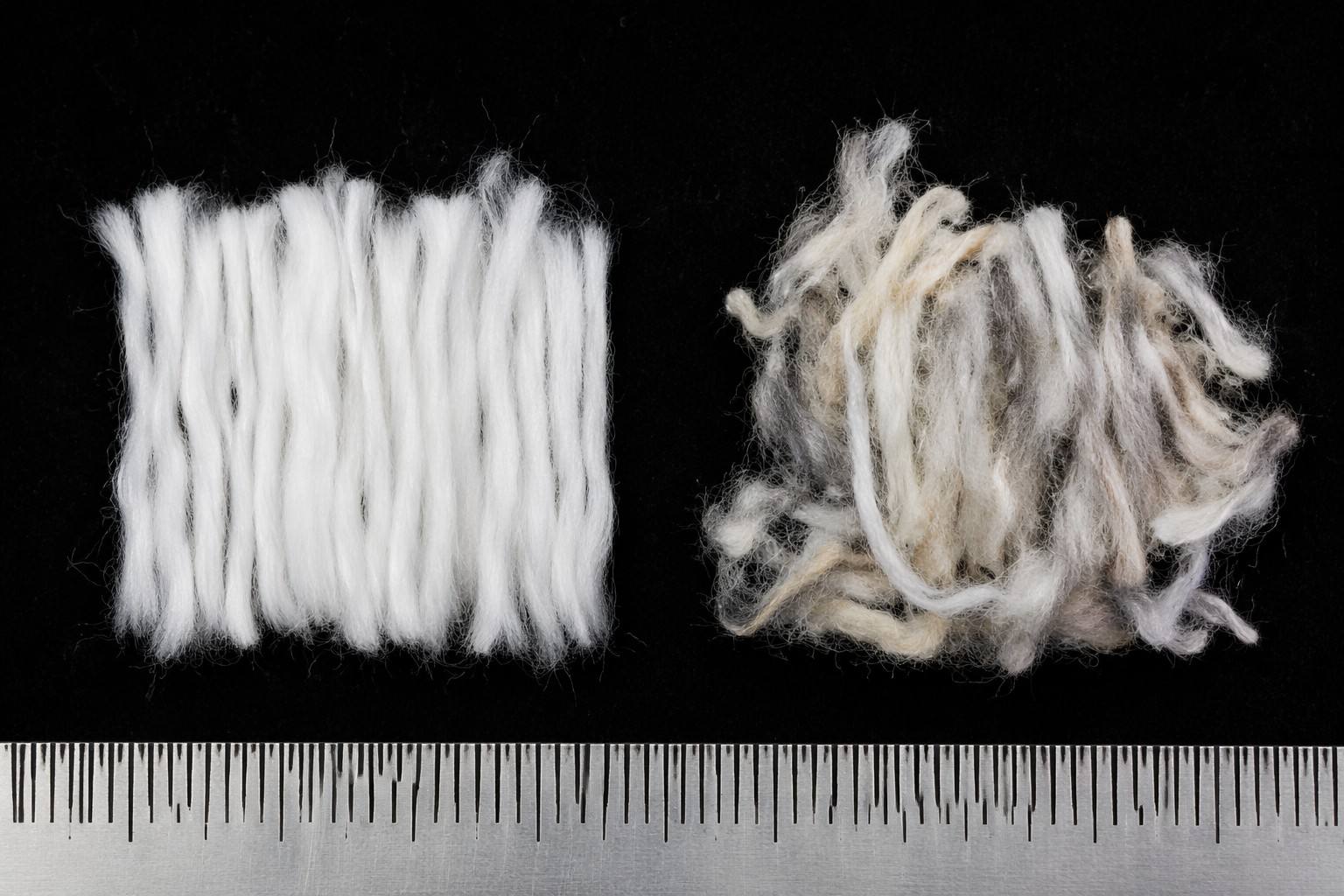
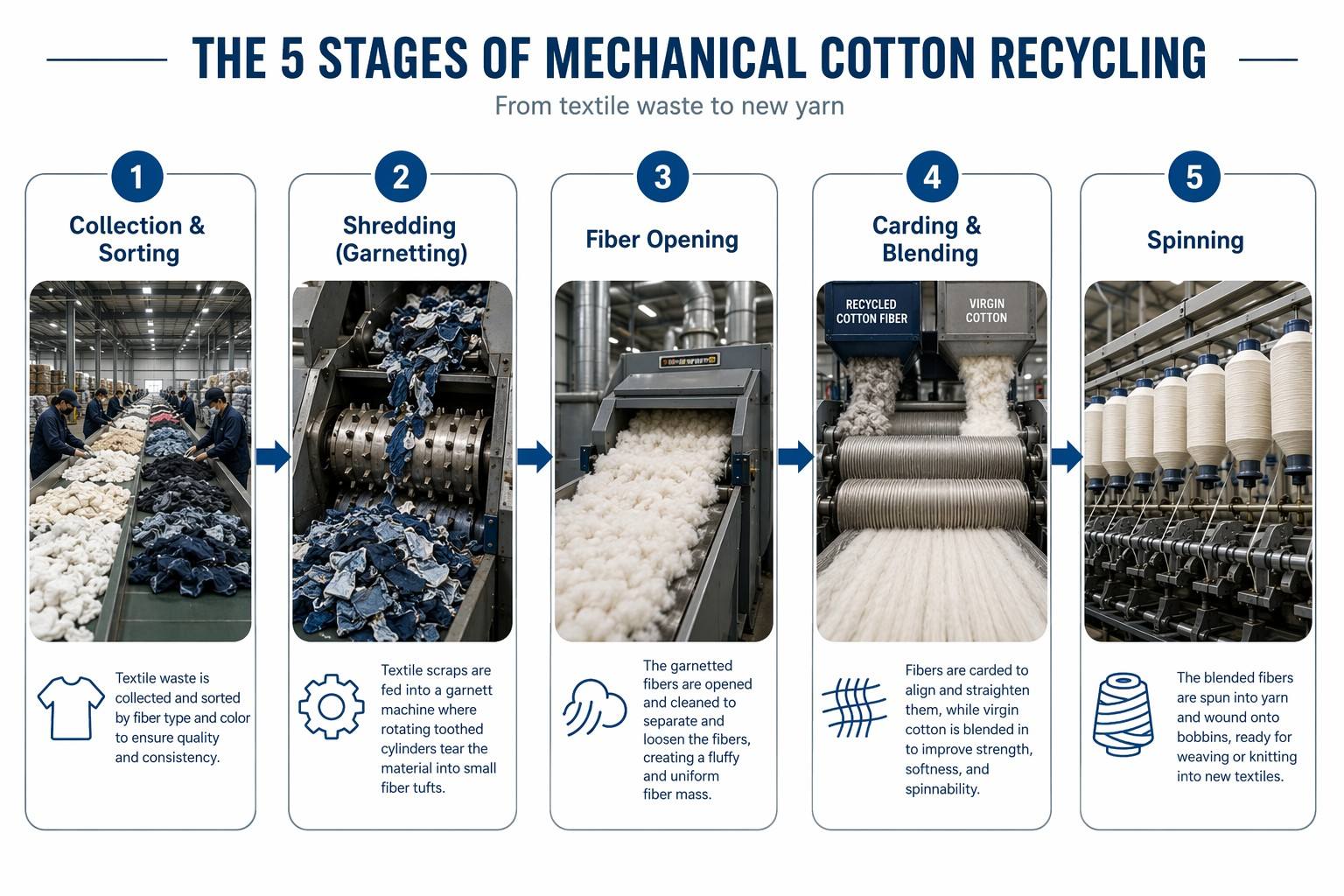
Recycled cotton is fiber reclaimed from textile waste — either pre-consumer (cutting scraps, selvedge, yarn waste from spinning and weaving) or post-consumer (used garments, household textiles). The fiber is extracted through a mechanical process: sorting by color, shredding through a garnett machine, and opening into short, irregular fibers that are then re-spun into yarn.

There are two distinct recycling routes:

Route

Process

Fiber Quality

Commercial Status

Mechanical recycling

Cutting → shredding → fiber opening → carding → spinning

Fiber length 10 — 22 mm; strength degraded by 30 — 50%

Mature; dominates current supply

Chemical recycling

Dissolution of cellulose → regeneration into continuous filament or staple (e.g., Circulose from Renewcell, Infinited Fiber)

Comparable to virgin-grade cellulose staple

Emerging; limited commercial scale

The vast majority of recycled cotton on the market today is mechanically recycled. This is also where the most significant quality trade-offs occur. Chemical recycling is worth monitoring for long-term supply chain planning, but for most buyers writing purchase orders in 2026, mechanical recycling defines the category.

A critical distinction: mechanically recycled cotton cannot be spun into yarn at 100% content. The fibers are too short and too weak. In practice, recycled cotton yarns contain 20–50% recycled content, with the balance consisting of virgin cotton, polyester, viscose, or Tencel to provide the structural backbone for spinning.

3. Fiber Property Comparison: The Data That Matters

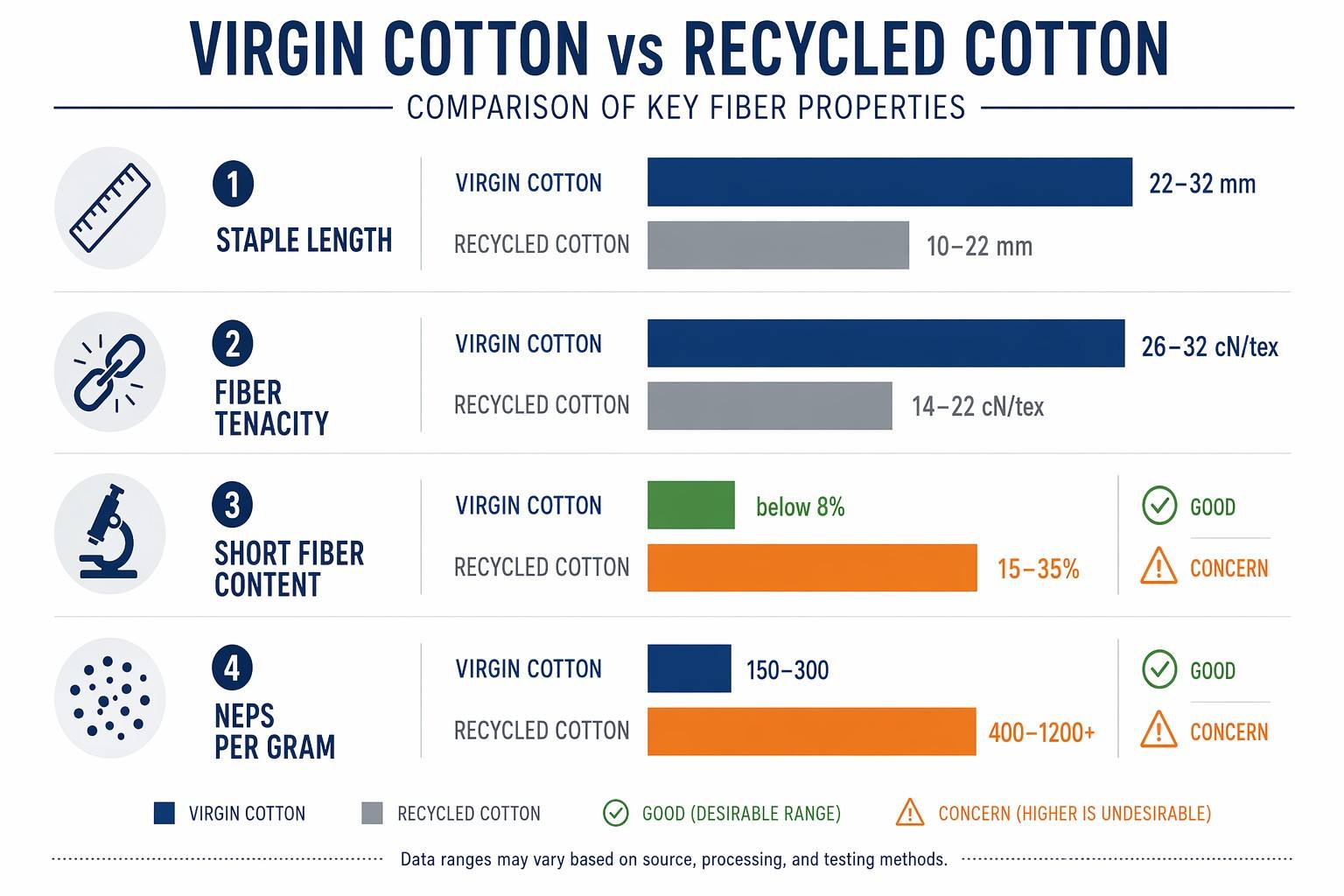
This is the table cotton suppliers rarely put in their brochures. These are measured ranges from commercially available mechanically recycled cotton fibers, benchmarked against standard virgin upland cotton.

Property

Virgin Cotton (Upland)

Recycled Cotton (Mechanical)

Manufacturing Impact

Staple length (mm)

22 — 32

10 — 22

Determines spinnable count ceiling

Short fiber content (%)

< 8%

15 — 35%

Higher SFC → more yarn breaks, higher fly generation

Tenacity (cN/tex)

26 — 32

14 — 22

Directly limits fabric tensile strength

Elongation at break (%)

6 — 9%

3 — 5%

Affects weaving/knitting tension tolerance

Neps per gram

150 — 300

400 — 1,200+

Impacts fabric appearance and dyeing evenness

Fiber length uniformity (%)

80 — 85%

55 — 70%

Causes CV% drift in yarn evenness

Micronaire

3.5 — 5.0

Variable; blend-dependent

Cannot be reliably specified in isolation

Trash / foreign fiber (%)

< 2%

1 — 8%

Higher risk of contamination from stitching thread, spandex fragments

Why Each Metric Matters on Your Production Line

Staple length and SFC together dictate the highest yarn count you can realistically spin. With mechanical recycled fiber at 15–22 mm, ring-spun yarns above Ne 21 become progressively more difficult. Open-end (rotor) spinning tolerates shorter fibers better, which is why most recycled cotton yarns in the Ne 6–Ne 20 range are rotor-spun. If your factory requires ring-spun Ne 30 or above, virgin cotton — or a recycled blend with high virgin content (65%+) — is the practical path.

Tenacity loss of 30–50% means the resulting fabric will have lower tear and tensile strength. This is especially relevant for knitwear that undergoes repeated washing (t-shirts, underwear) or woven applications where seam slippage is a concern. A recycled cotton jersey may achieve 70–80% of the bursting strength of an equivalent virgin cotton jersey at the same GSM.

Neps and contamination directly affect fabric appearance. Neps create visible white specks on dyed fabric. Foreign fibers — particularly spandex fragments from post-consumer waste or polyester sewing thread from cutting scraps — appear as undyeable defects. For solid-color or critical-appearance applications, specify a nep count ceiling in your quality agreement and request pre-production nep-testing reports.

4. Blend Requirements: Recycled Cotton Cannot Stand Alone

The most common question from first-time recycled cotton buyers: “Can I order 100% recycled cotton yarn?” The answer is no — not from any commercially viable mechanical recycling line.

The table below shows realistic blend ratios based on industry practice and what Fangtuosi has observed across recycled cotton sourcing programs:

Yarn Count (Ne)

Max Recycled Content

Common Carrier Fiber

Spinning Method

Ne 6 — Ne 10

50 — 65%

Virgin cotton or reclaimed polyester

Open-end

Ne 16 — Ne 21

30 — 50%

Virgin cotton

Open-end or Ring

Ne 24 — Ne 30

20 — 35%

Virgin cotton or viscose

Ring (carded)

Ne 32+

< 20%

Virgin long-staple cotton

Ring (combed)

The carrier fiber — the virgin component in the blend — provides the mechanical strength and length continuity that the recycled fiber lacks. Polyester is frequently used as the carrier in low-cost open-end yarns for industrial wipes, cleaning cloths, and low-grade knitwear. For apparel-grade fabrics where hand feel and breathability matter, virgin cotton or a cotton-rich blend (e.g., 60% virgin + 40% recycled) is preferred.

5. Yarn Quality: What the Uster Tester Reveals

Spinning mills running Uster or Premier testing equipment report four key parameters that reveal the gap between virgin and recycled cotton blends:

Yarn Parameter

Virgin Cotton (Ne 30)

Recycled Blend (Ne 20, 30% recycled)

CVm (mass variation, %)

10 — 13%

14 — 18%

Thin places (-50%) / km

2 — 10

15 — 40

Thick places (+50%) / km

30 — 80

80 — 200

Neps (+200%) / km

50 — 150

150 — 400

Hairiness (H)

3.5 — 4.5

4.5 — 6.0

Higher CVm and nep counts in recycled blends mean the yarn is more likely to cause stoppages on high-speed knitting machines (especially single-jersey circular machines running above 25 RPM) and will produce fabric with visible unevenness under flat-table inspection.

For buyers: if your knitting mill has a maximum CVm tolerance, communicate this before the PO is issued. Many recycled yarn suppliers can meet a CVm ≤ 16% for Ne 20 blends, but Ne 24 and above requires tighter raw material sorting and more sophisticated blending in the opening line — capabilities that distinguish top-tier recycled yarn mills from commodity suppliers.

6. Dyeing Behavior: Where Factories Lose Money

Dyeing recycled cotton blends is not the same as dyeing virgin cotton. The difference in dye uptake between the virgin and recycled components within the same yarn creates what dyers call “ring dyeing” or “core-skin” unevenness — the recycled fiber, having already been processed, dyed, and mechanically degraded, absorbs reactive dyes differently than virgin fiber.

Key production risks:

Shade variation: The virgin and recycled fractions in a single yarn take dye at different rates. A target shade that requires 2% owf dye concentration on virgin cotton may need 2.3–2.8% to achieve the same visual depth on a recycled blend, increasing chemical and water costs.

Batch-to-batch consistency: Recycled cotton feedstock is inherently variable — one batch of cutting scraps may originate from a different mill, with different base cotton, than the previous batch. Dye recipes may require adjustment between lots. Request color continuity samples from each new lot before bulk production.

Color fastness: Rubbing fastness (crocking) and washing fastness on recycled blends typically score 0.5–1.0 grade lower than virgin cotton fabrics on the AATCC scale, because the shorter recycled fibers are more prone to surface migration.

Experienced dyehouses compensate with longer pre-scouring cycles and optimized salt-alkali dosing curves. If you are qualifying a new recycled cotton supplier, run a lab-dip trial with at least three lots of yarn to confirm repeatability before scaling to bulk.

7. Cost Structure: Why Recycled Is Not Always Cheaper

Many buyers assume recycled cotton yarn is cheaper because the raw input is waste. The reality is more nuanced:

Cost Component

Virgin Cotton Yarn (Ne 20)

Recycled Blend Yarn (Ne 20, 30% recycled)

Raw fiber (USD/kg)

$1.80 — 2.50

0.30−−0.80(waste)+0.30−−0.80(waste)+1.80 — 2.50 (virgin carrier)

Sorting & preparation

Not applicable

$0.20 — 0.50

Spinning cost

Standard

15 — 30% higher (more breaks, slower speeds)

Quality control & testing

Standard

Additional nep/short fiber testing per lot

Typical total (USD/kg)

$2.80 — 3.80

$2.50 — 4.20

The waste feedstock is cheap, but the sorting, shredding, and blending labor is intensive. Spinning efficiency is lower because yarn breaks occur more frequently. And the mandatory virgin blend component means you are still exposed to virgin cotton price volatility. In some market conditions, recycled yarn at comparable counts can be more expensive than virgin yarn.

The economic case for recycled cotton improves when:

You are spinning coarse counts (Ne 6 — Ne 12) where quality demands are lower

You are sourcing from regions with established textile waste collection networks (India’s Tirupur cluster, Bangladesh, Turkey)

Your customers are willing to pay a sustainability premium that absorbs the processing cost delta

Yield note: The mechanical recycling process converts approximately 40–65% of input textile waste into usable fiber, depending on waste quality and the target yarn specification. The remaining fraction becomes short fiber dust, waste, and unusable material. Factor this yield loss into your supplier’s pricing logic.

8. Certifications: What a Buyer Must Verify

If you are marketing your finished garments as containing recycled cotton, certification is not optional. Brands and retailers increasingly require documented proof of recycled content claims to comply with EU Green Claims Directive and similar regulations.

The Two Recycled Content Standards

Standard

Issuing Body

Recycled Content Threshold

Key Requirement

GRS (Global Recycled Standard)

Textile Exchange

≥ 20% recycled content per product

Full chain of custody + social + environmental + chemical criteria

RCS (Recycled Claim Standard)

Textile Exchange

≥ 5% recycled content per product

Chain of custody only; no social/environmental criteria

GRS is the dominant standard for apparel — it carries stronger market recognition and is required by most European brand sustainability programs. RCS is lighter, suitable when your buyer only needs to verify recycled content without the full GRS audit burden.

The TC Flow

Both standards use a Transaction Certificate (TC) system. Every entity in the supply chain that takes ownership of certified material must be scope-certified and issue a TC to the next buyer:

Waste collector (SC) → Recycled fiber producer (SC) → Yarn spinner (SC) → Fabric mill (SC) → Garment factory (SC) → Brand

SC = Scope Certificate holder. If any link in the chain lacks a valid scope certificate, the chain is broken and the final product cannot carry a GRS/RCS claim.

Before placing an order, request your recycled cotton yarn supplier’s current scope certificate (not just the certificate number — the full PDF). Verify:

The scope certificate’s expiry date

That the certificate covers the specific recycled fiber type (cotton, not generic “textile waste”)

That your supplier is listed as an active facility, not an expired one

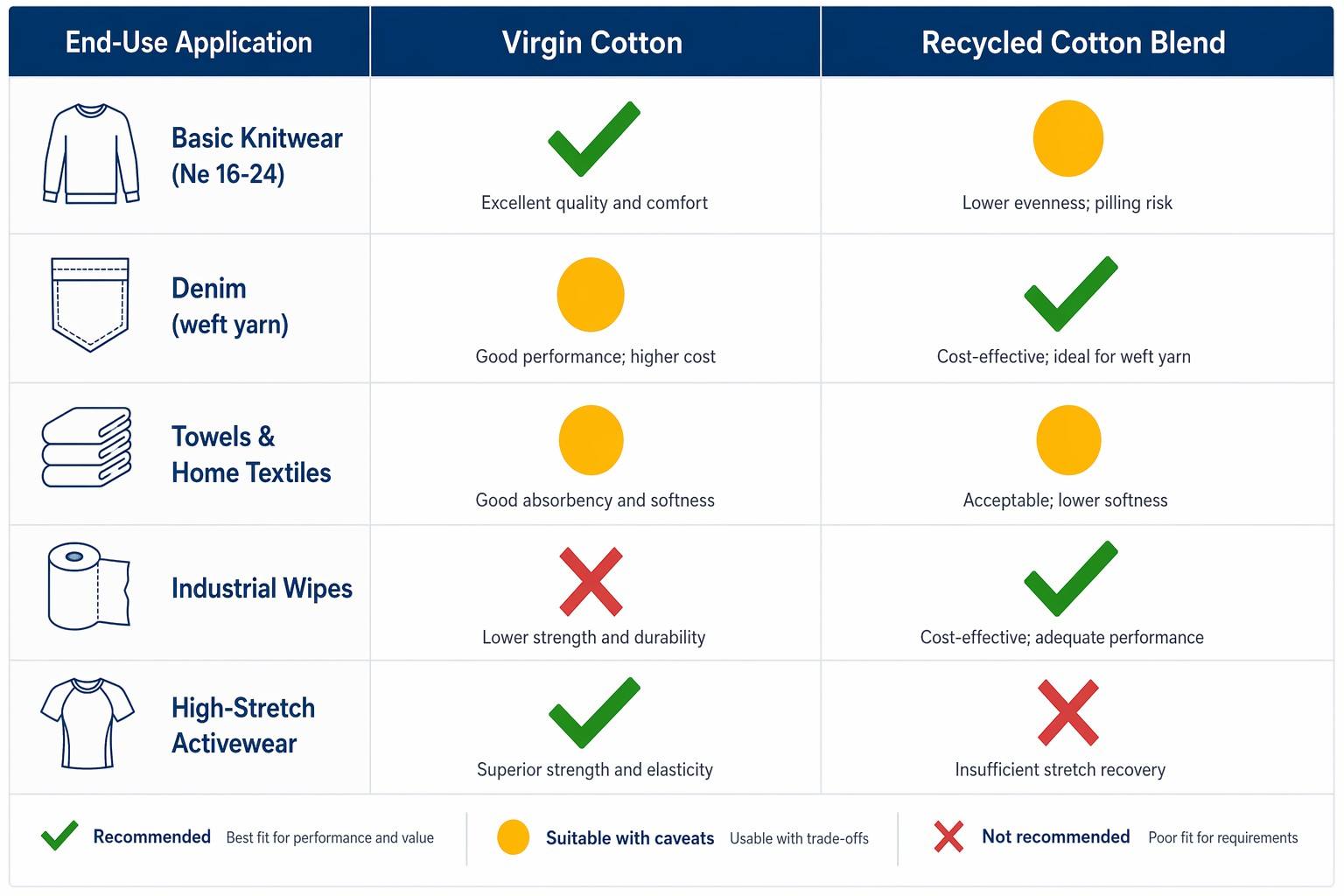
9. End-Use Applications: Where Each Fiber Fits

Application

Recommended Fiber

Typical Blend

Reason

Premium knitted t-shirts (Ne 30+)

Virgin cotton

100% cotton or cotton-elastane

Evenness, hand feel, dyeing consistency

Basic casual knitwear (Ne 16–24)

Recycled cotton blend

30–50% recycled + virgin cotton

Acceptable quality with sustainability claim

Denim (weft yarn, Ne 6–12)

Recycled cotton blend

20–35% recycled

Denim’s texture-tolerant aesthetic masks unevenness

Home textiles (towels, bedding)

Virgin or recycled blend

20–30% recycled content possible

Higher nep tolerance; post-consumer feedstock can be used

Cleaning cloths, industrial wipes

Recycled cotton

50–100% recycled (open-end)

Low quality requirements; maximum waste utilization

Non-wovens (insulation, automotive felt)

Recycled cotton

Up to 100% post-consumer

Minimal mechanical demands

High-stretch activewear

Virgin cotton-spandex or recycled polyester

Not applicable

Recycled cotton’s low tensile strength incompatible with spandex-level stretch demands

10. Sourcing Geography: Where to Find Quality

Recycled cotton is not produced everywhere at equal quality. The supply is concentrated in regions with both dense textile manufacturing and established waste collection networks:

Region

Key Hub

Typical Output

Quality Notes

India

Tirupur, Panipat

Primarily open-end Ne 6–16, some ring Ne 20

Largest global supplier; variable quality; Panipat specializes in post-consumer shoddy

Bangladesh

Dhaka, Narayanganj

Open-end Ne 10–20

Feedstock heavily from RMG cutting waste; consistent pre-consumer quality

China

Zhejiang, Jiangsu

Open-end Ne 6–21, some ring spun

Improving quality; integrated with domestic waste streams

Turkey

Istanbul, Denizli

Ring-spun Ne 16–30

Highest quality recycled cotton globally; consistent pre-consumer supply base

Pakistan

Faisalabad

Open-end Ne 7–16

Competitive pricing; limited GRS-certified volume

Turkish recycled cotton commands a premium because the supply chain — predominantly pre-consumer cutting waste from Turkey’s large garment export industry — delivers cleaner, more consistent feedstock than the mixed post-consumer streams common in South Asian markets.

For Chinese buyers sourcing from regional suppliers, Zhejiang and Jiangsu mills have invested in automated color-sorting and multi-stage fiber opening lines that improve quality consistency, closing the gap with Turkish supply.

11. Sustainability: The Honest Comparison

Recycled cotton’s environmental case is real but boundary-constrained. Measuring impact requires defining the system boundary clearly.

Metric

Virgin Cotton

Recycled Cotton (Mechanical)

Water consumption (per kg fiber)

7,000 — 29,000 L (varies by irrigation)

Avoids agricultural water (the largest component); processing water ~50 L/kg

Carbon footprint (kg CO2e/kg fiber)

2.0 — 3.5

0.5 — 1.5 (processing only)

Landfill diversion

None

25 billion lbs annual global textile waste partially diverted

Chemical inputs

Fertilizer, pesticide, defoliant (conventional); none (organic)

Scouring agents only; no agricultural chemicals

Biodegradability

Fully biodegradable (cellulose fiber)

Biodegradable, but carrier fiber (e.g., polyester) may not be

Re-recyclability

Not applicable

Cannot be mechanically recycled again without further fiber degradation

The boundary problem: Virgin cotton’s environmental burden is dominated by agriculture (water, land, agrochemicals). Recycled cotton shifts the burden to collection, sorting, and transportation logistics. If post-consumer garments are collected door-to-door across Europe, shipped to India for sorting, trucked to Panipat for shredding, then shipped again as yarn to Bangladesh for garment production, the cumulative transport footprint erodes the recycling benefit. Pre-consumer waste sourced locally within the same manufacturing cluster minimizes this trade-off.

The biodegradability advantage of virgin cotton is a genuine differentiator that recycled blends cannot claim if the carrier fiber is synthetic. A 70% recycled cotton / 30% virgin polyester blend will shed microplastic fragments during washing and persist in the environment if landfilled. For brands whose sustainability story centers on biodegradability and microplastic-free textiles, 100% virgin cotton — or a 100% cellulosic blend — remains the only verifiable claim.

12. FAQ

Q: Can recycled cotton be recycled again?

No — not through mechanical recycling. Each shredding cycle reduces fiber length by an additional 30–50%. After one recycling pass, the fiber is already down to 10–22 mm; a second pass would produce fiber too short for any spinning process. This is why recycled cotton is described as “downcycled” rather than “truly circular.” Chemical recycling may eventually enable multiple recycling cycles, but the technology is not yet at commercial scale for cotton.

Q: What percentage of recycled cotton is typically used in commercial yarns?

For apparel-grade yarns: 20–35% recycled content is standard. Claims above 50% are achievable only in coarse open-end counts (Ne 6–10) for low-grade applications. Any supplier offering “100% recycled cotton yarn” via mechanical recycling is misrepresenting their product — ask for a fiber composition test report.

Q: Is recycled cotton more expensive than virgin cotton?

It can be. While the waste feedstock costs near zero, sorting, shredding, blending, and slower spinning speeds add processing overhead. For fine-count ring-spun yarns (Ne 24+), recycled blends are often priced at a 5–15% premium over equivalent virgin yarn. For coarse open-end yarns (Ne 6–12), recycled is typically 10–25% cheaper. The answer depends entirely on yarn count and quality specification.

Q: Does recycled cotton fabric feel different to the touch?

Yes. Recycled cotton fabrics typically feel slightly rougher and less uniform than their virgin counterparts. This is due to higher short fiber content, which protrudes from the yarn surface as micro-hairs. Enzyme wash or bio-polishing can improve hand feel, but adds processing cost. For applications where “soft” is the primary selling point (premium t-shirts, baby garments), virgin cotton remains the superior choice.

Q: How can I verify if cotton is genuinely recycled?

Request the following from your supplier:

A valid GRS or RCS scope certificate covering recycled cotton

The transaction certificate (TC) for your specific lot

A fiber composition test report from an accredited lab (e.g., SGS, Intertek, Bureau Veritas) showing recycled content

A nep/short fiber test report if you have set quality thresholds

Fiber composition testing can distinguish virgin from recycled cotton fibers under microscopy (fiber damage markers, length distribution anomalies), but it requires an experienced textile lab. The certification chain is the more practical verification path for commercial transactions.

Q: What certifications should a recycled cotton yarn supplier hold?

At minimum: GRS or RCS. For apparel destined for the EU, also verify OEKO-TEX Standard 100 (chemical safety) and, if organic cotton is used as the virgin carrier, GOTS. Some buyers additionally require the supplier’s social compliance audit (BSCI, Sedex, or SA8000), particularly when GRS certification is in place — GRS already includes social criteria, but some brands mandate an additional independent audit.

13. Decision Framework: When to Choose Which

If your priority is…

Choose…

Because…

Yarn evenness and low defect rate (Ne 24+)

Virgin cotton

Recycled blends cannot match Uster CV% at fine counts

Hand feel and consumer comfort

Virgin cotton or recycled blend ≤ 30%

Higher recycled content degrades softness

Sustainability marketing with measurable impact

Recycled cotton blend (20–40%)

Diverts textile waste; GRS-certified claim

Lowest per-kg cost (coarse yarns, Ne 6–16)

Recycled cotton blend

Waste feedstock is near-zero cost

Biodegradability claim

Virgin cotton (100% cotton)

No synthetic carrier fiber; fully biodegradable

Regulatory compliance (EU market)

Both; verify GRS/RCS/OEKO-TEX

Virgin cotton and recycled both certifiable; recycled adds GRS layer

Color-critical or solid-dye applications

Virgin cotton

Recycled batch-to-batch dye consistency is inherently harder to control

Circular economy narrative

Recycled cotton (pre-consumer)

Closest to closed-loop with current technology

Conclusion

Virgin cotton and recycled cotton are not interchangeable — they are different materials with different manufacturing constraints, different cost drivers, and different quality profiles. The CottonWorks article from Cotton Incorporated positions virgin cotton as unequivocally superior, but the real answer is more nuanced: recycled cotton has a legitimate and growing role in the textile supply chain, provided buyers understand the limitations and write specifications accordingly.

For procurement managers: define your yarn count and quality tolerance before deciding on fiber type. For quality managers: set nep limits and CV% targets in your PO rather than accepting generic “recycled cotton yarn” specifications. For sustainability leads: verify the full certification chain and consider the transport boundary when calculating net environmental benefit.

Fangtuosi supplies both virgin cotton fabrics and recycled-content blends, with GRS and OEKO-TEX certified production. Whether your next order calls for premium 100% cotton single jersey or a recycled cotton-polyester open-end yarn for sustainable knitwear, we can provide specification sheets, lab-dip services, and TC documentation before you commit to bulk.

Internal Link Placement Summary

Section

Anchor Text / Context

Target URL

Section 1 (Virgin Cotton)

Browse virgin cotton fabric options

Cotton Fabric category

Section 2 (Recycled Cotton)

Explore recycled fabric products

Recycled Fabric category

Section 4 (Blend Requirements)

See CVC/TC cotton-polyester blends

CVC/TC Fabric sub-category

Section 8 (Certifications)

Learn about production facilities and quality standards

Factory Show page

Section 9 (End-Use Applications)

Browse cotton-spandex fabrics

Cotton Spandex sub-category

Section 10 (Sourcing Geography)

Contact our sourcing team

Contact page

Section 12 (FAQ)

Visit our FAQ page

FAQ page

Conclusion (CTA)

Inquire about specifications and documentation

Contact page

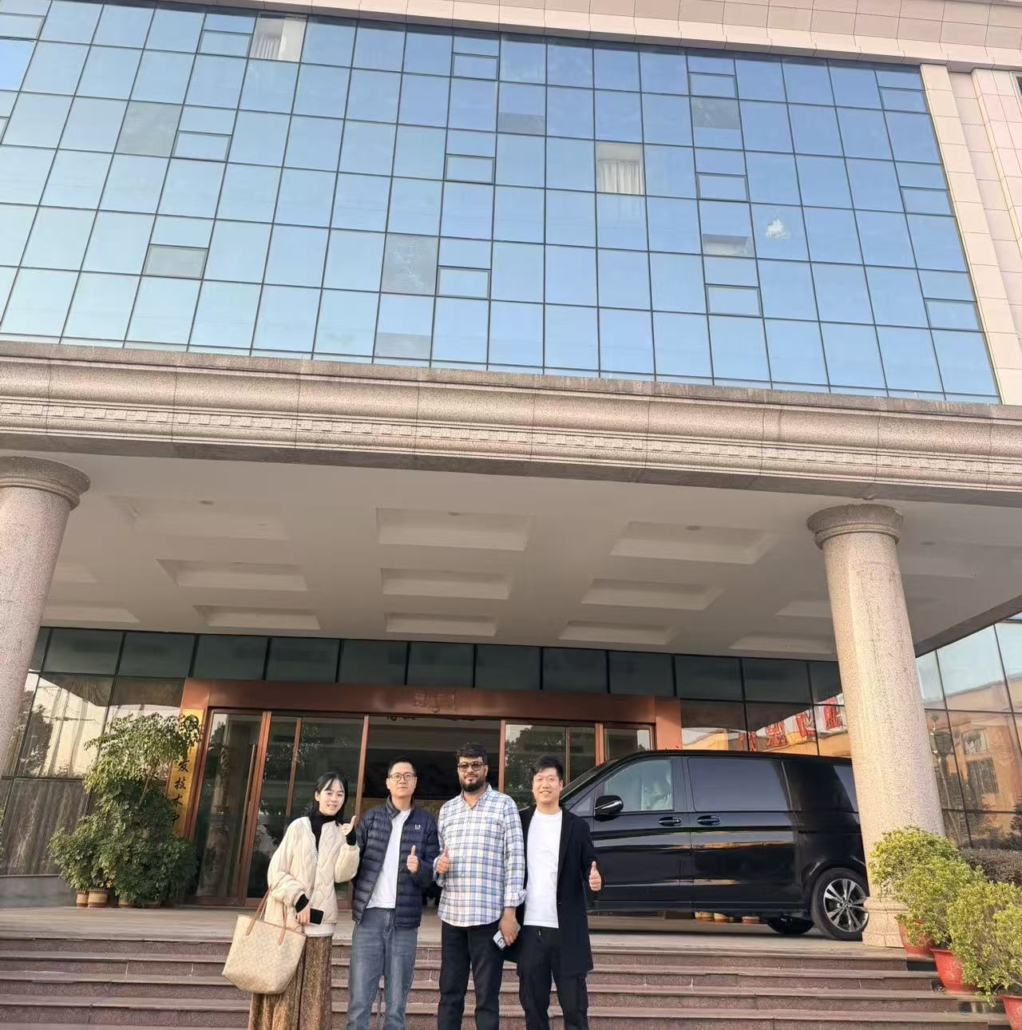
Global Client Visits Our Factory

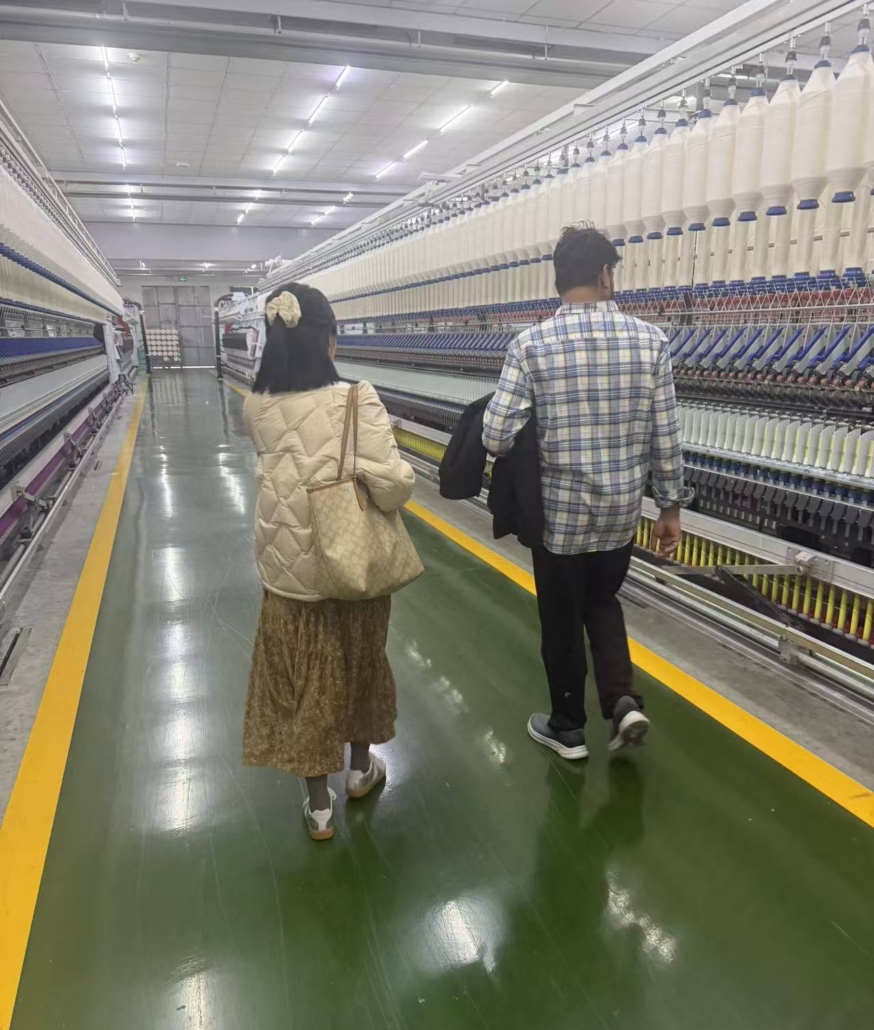
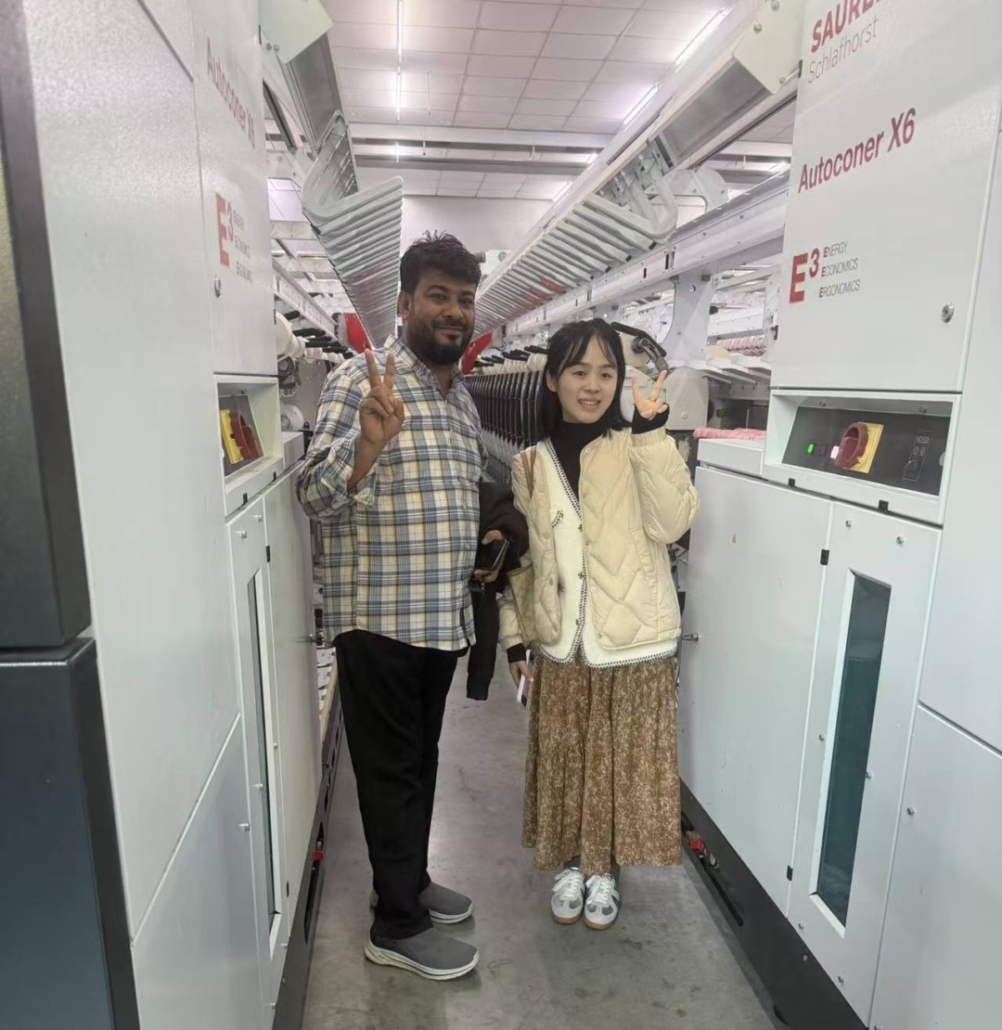
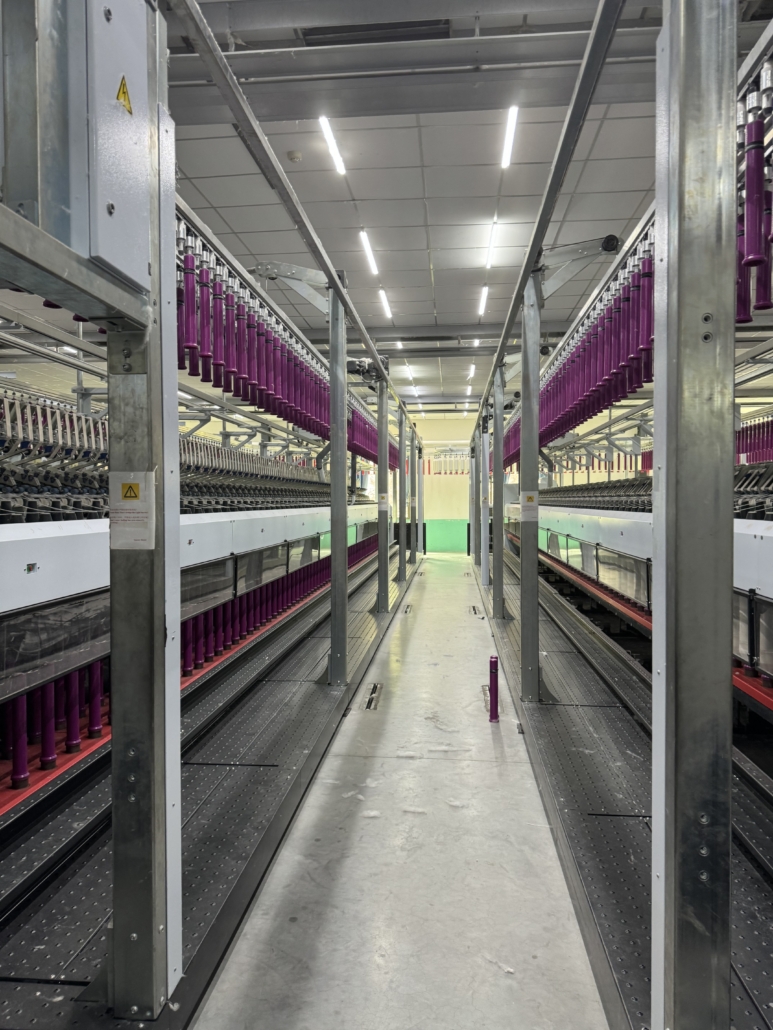
[Sanming, Nov.25th, 2025]– our yarn factory,proudly hosted a distinguished international client for an in-depth factory tour, showcasing our state-of-the-art production capabilities, rigorous quality control, and commitment to sustainable manufacturing. The visit reinforced our reputation as a trusted partner in the global textile industry.

A Comprehensive Tour of Our Production Excellence

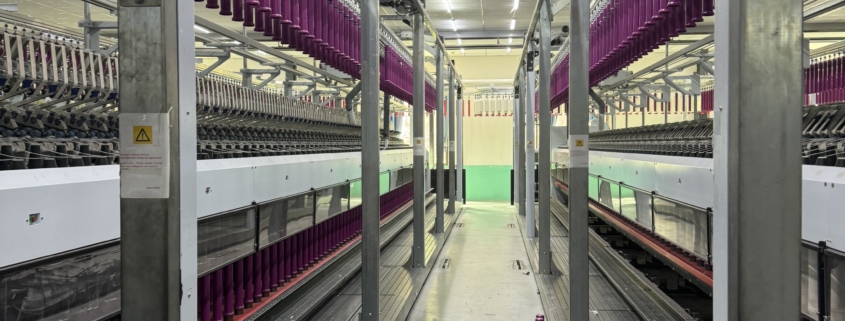
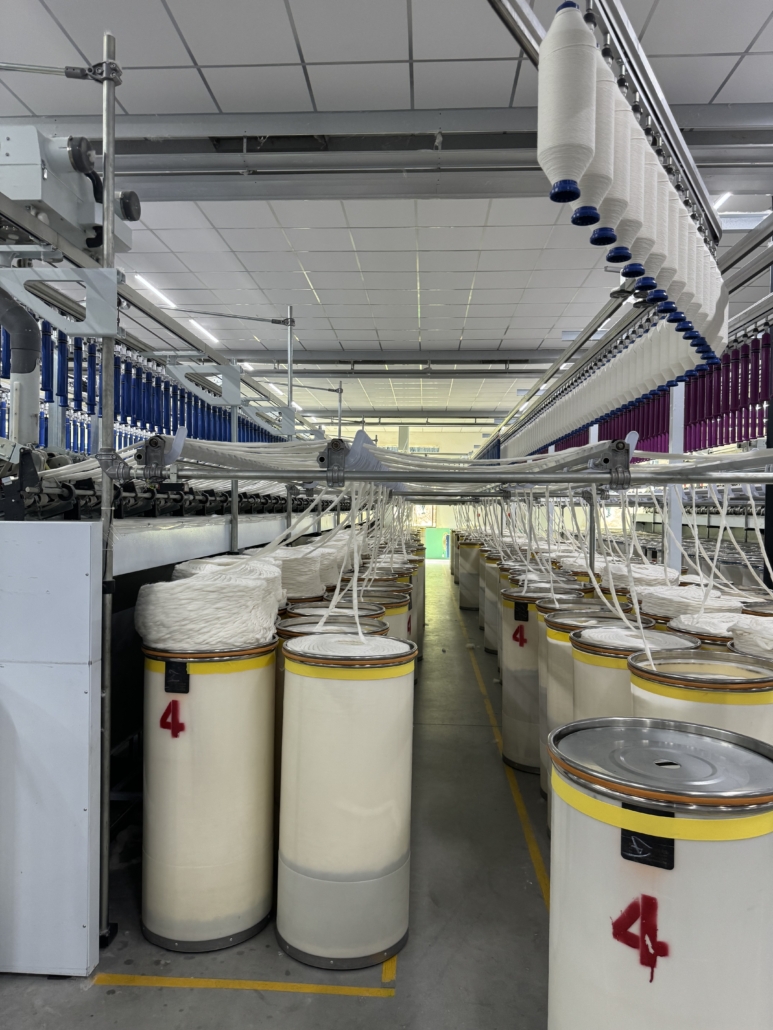
The client was guided through every critical stage of yarn manufacturing, from raw material processing to finished product packaging. The tour highlighted our vertically integrated production line, designed to ensure consistency, efficiency, and uncompromised quality:   

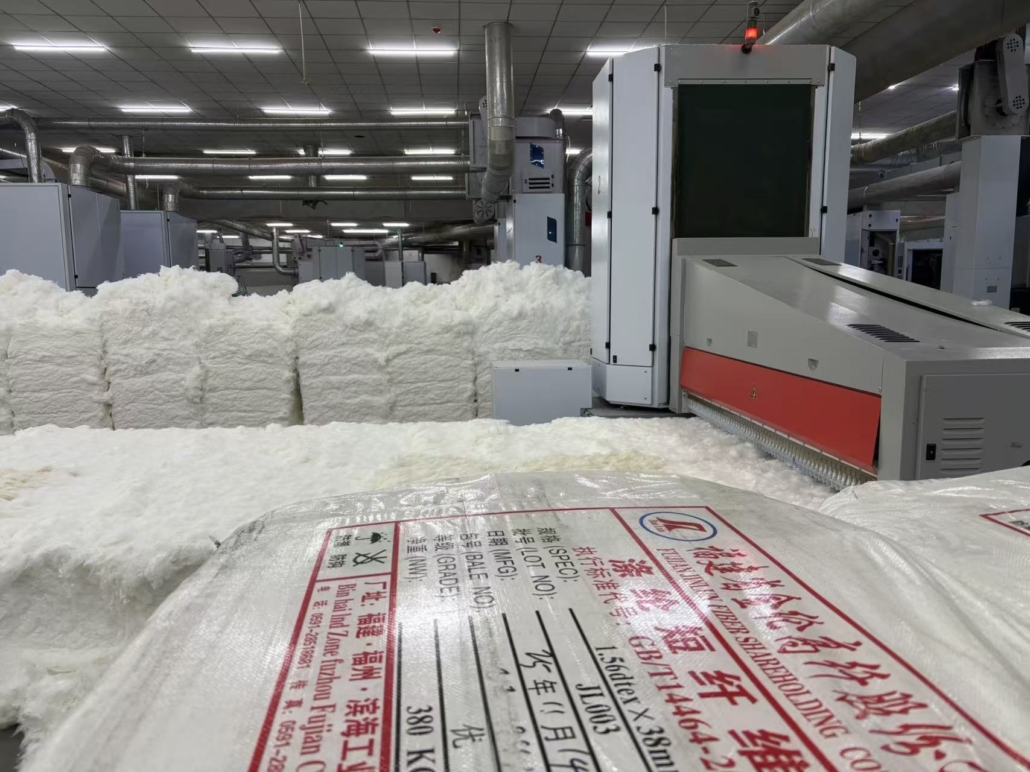
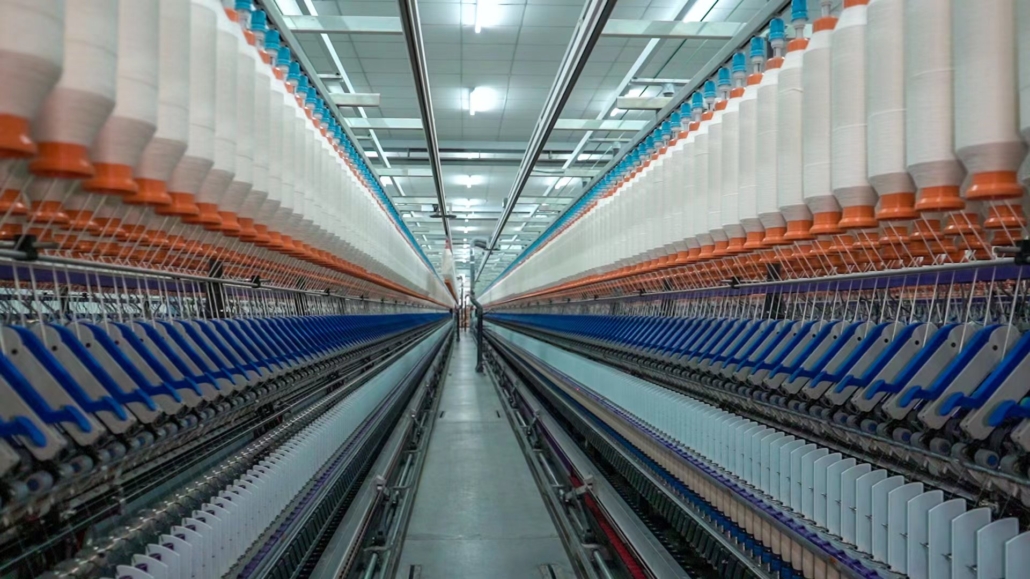
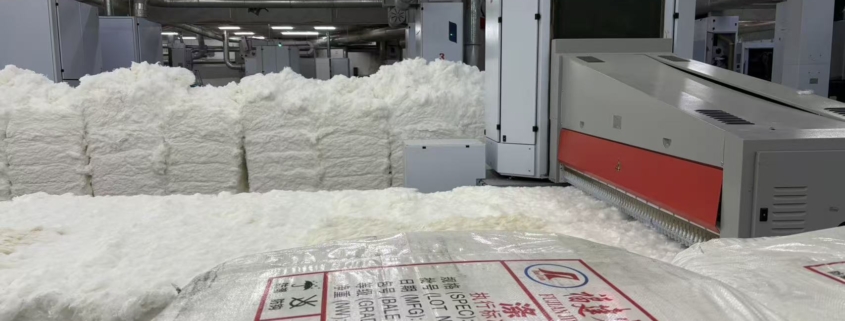
  • Blowing/Opening & Mixing: Demonstrating precision in loosening and blending raw fibers (cotton, polyester, and blends) to achieve uniform composition.
recycle cotton
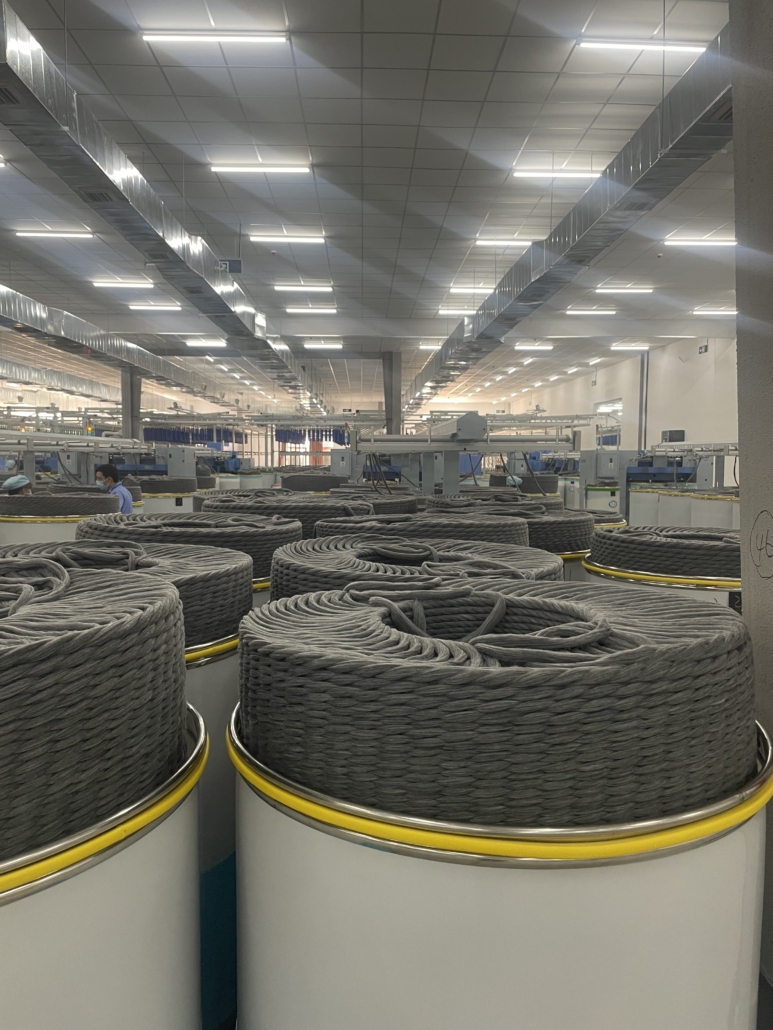
  • Carding: Showcasing advanced machinery that transforms loose fibers into a parallel, web-like structure, removing impurities and short fibers.
  • Drawing: Illustrating how multiple fiber slivers are combined and drafted to enhance evenness and strength.
  • Roving: Explaining the process of thinning and lightly twisting fiber strands to create a cohesive intermediate product.
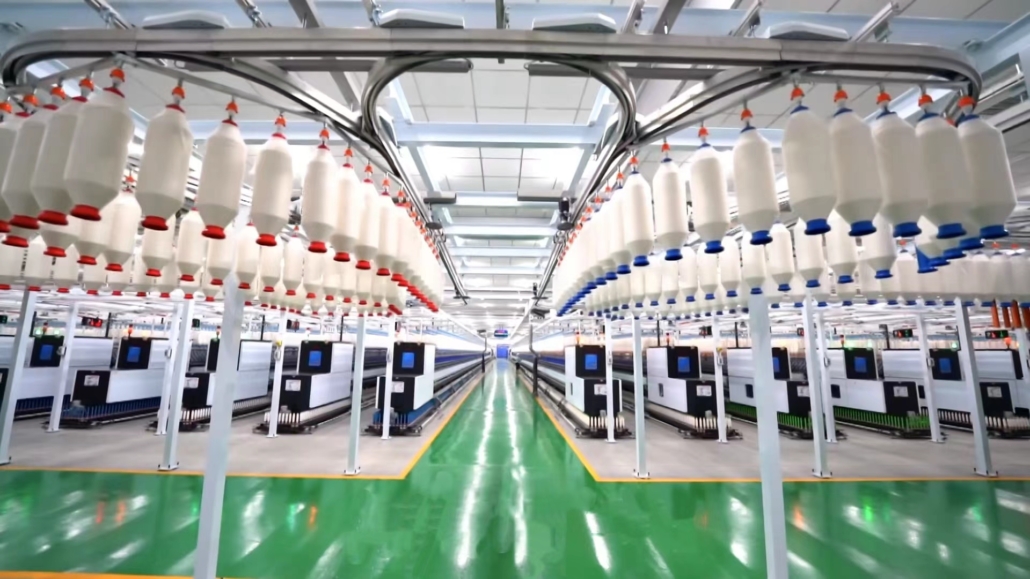
  • Spinning: Highlighting the core stage where roving is stretched to the desired fineness (yarn count) and twisted to form strong, uniform yarn.
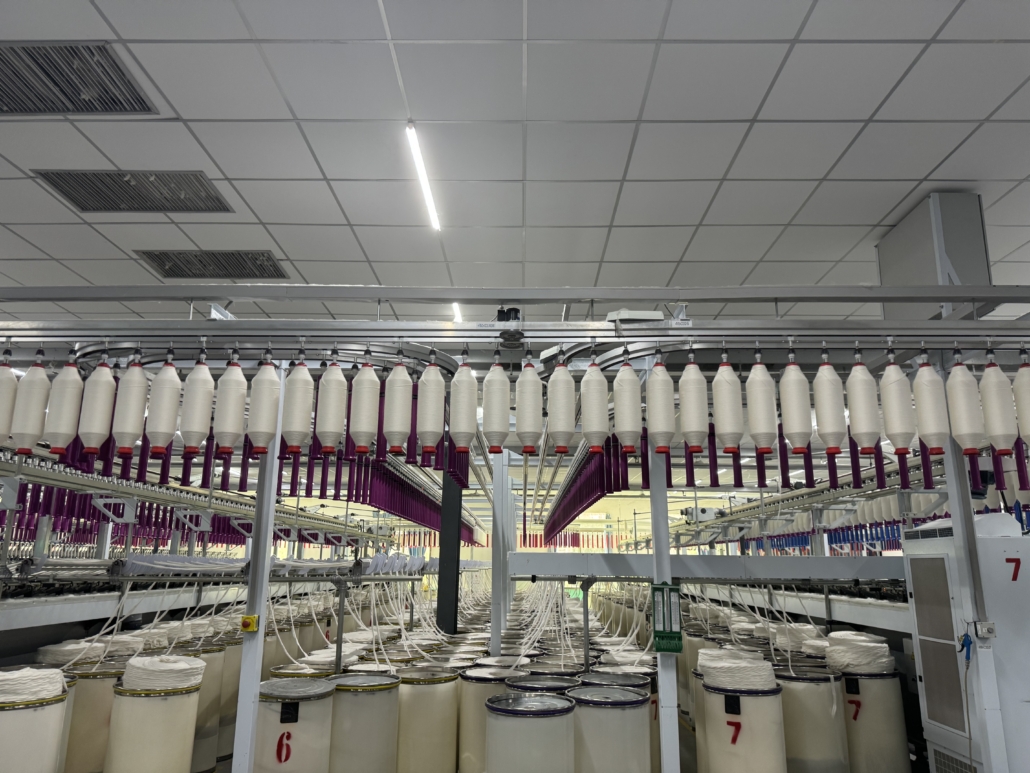
  • Winding: Featuring automated machines that clear yarn defects and wind yarn onto cones for further processing.
  • Yarn Reeling & Packing: Concluding with precise reeling into fixed-length skeins and secure packaging for shipment.


Warehouse & Product Showcase: Diversity Meets Quality

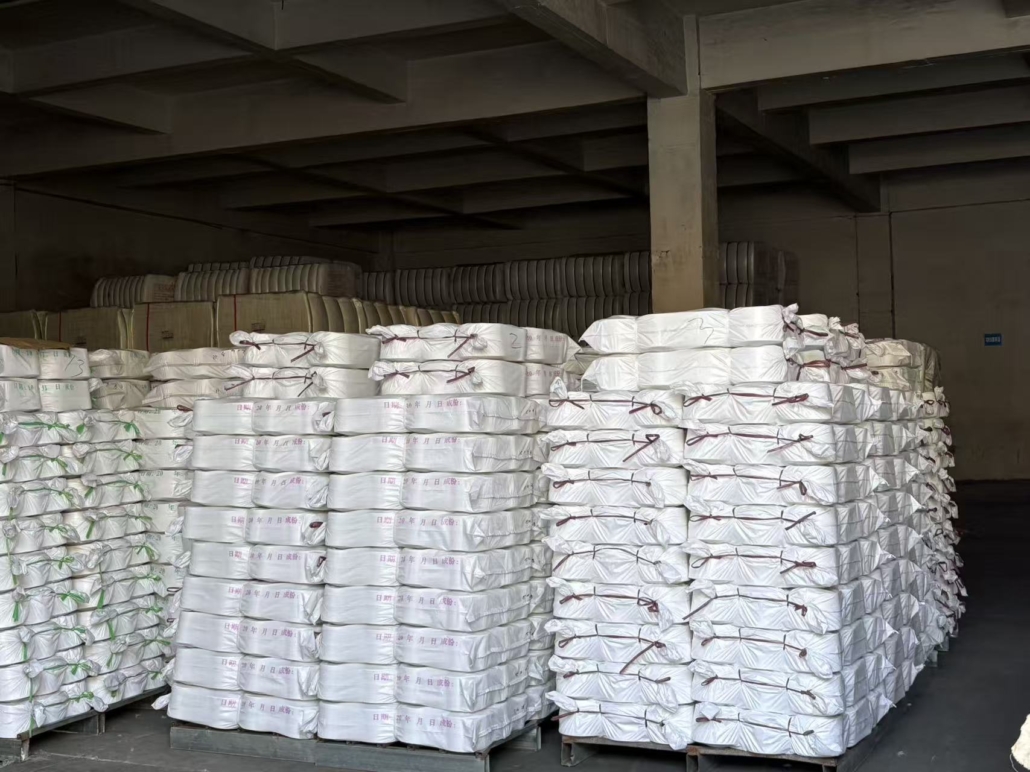
Beyond the production floor, the client explored our spacious warehouse, which houses a wide range of yarns—including polyester filament (FDY/DTY/POY), spun yarns, recycled polyester (rPET) yarns, and specialty blends. Our team presented customized solutions tailored to various applications (apparel, home textiles, technical textiles), emphasizing our ability to meet diverse market demands.

Quality Validation: Customer Samples Speak Volumes

A key highlight of the visit was the client’s side-by-side comparison of our yarns with their own samples. Our products demonstrated superior evenness, strength, and color consistency, earning direct praise: “Your quality is evidently better—from fiber selection to final packaging, every detail reflects professionalism.”The client also commended our clean production environment, large-scale facilities, and transparent quality control processes (including in-line testing and third-party certifications like GRS and OEKO-TEX).

what is yarn

Overview

Yarn serves as the fundamental building block of textiles, transforming raw fibers into continuous strands that create the fabrics shaping our world. Whether in clothing, home textiles, or industrial applications, yarn’s versatility makes it indispensable to modern life. This guide explores yarn’s core concepts, production processes, and diverse applications.

Definition and Basic Composition

Yarn is a continuous and elongated body made by twisting textile fibers. As an intermediate material connecting fibers and fabrics, it is widely used in the field of textile and clothing. Its definition covers both traditional short fiber yarns and long fibers.

According to the raw materials, it can be divided into natural fiber yarn (cotton/linen), chemical fiber yarn (polyester/nylon), and blended yarn.

According to the production method, it can be divided into process categories such as ring spinning and air flow spinning, with structural forms including single yarn, stranded yarn, and deformed yarn.

The performance of yarn is determined by fiber properties and structural parameters such as twist and twist direction. Twist affects yarn strength and feel, twist direction regulates fabric gloss and pattern morphology, and fineness is measured by indicators such as tex and metric count.

The traditional spinning process includes three stages: opening and combing, merging and stretching, and twisting and winding. Modern technology has developed new processes such as siro spinning and agglomeration spinning to improve yarn uniformity and functionality. Special yarns such as floral threads achieve decorative effects through a composite structure of core and decorative yarns, while deformable yarns improve the fluffiness and comfort of synthetic fibers. Sewing threads need to be adapted to the shrinkage and durability requirements of different fabrics.

Types of Yarn

Yarn is categorized based on fiber length, structure, and processing method:

1. Spun Yarns

Made from short fibers (natural short fibers or synthetic cut fibers) twisted together, divided into ring spun yarn, free end spun yarn, and self spun yarn.Examples include cotton and wool yarns. They offer softness, warmth, and a matte appearance but may have lower strength compared to filament yarns.

2. Filament Yarns

Continuous filament, such as natural silk and synthetic filament, with or without spinning, smooth filament or deformed filament, etc. Variants include:

​​FOY​​ (Fully Oriented Yarn): High strength, low elongation

​​POY​​ (Partially Oriented Yarn): Used as feedstock for texturing

​​DTY​​ (Draw Textured Yarn): Elastic and bulky, ideal for knitting

3. Blended Yarns

Short fiber and continuous filament combination yarn.

Combine different fibers (e.g., polyester-cotton) to enhance performance, durability, and cost-efficiency. , such as polyester cotton filament core spun yarn. Thread is made by combining and twisting two or more strands of single yarn.

Key Production Processes

Yarn manufacturing varies by fiber type:

​​Spun Yarn Production

​​Opening & Blending: Loosening and mixing fibers

​​Carding: Aligning fibers into a thin web

​​Drawing: Evening and paralleling fiber strands

​​Spinning: Twisting drafted strands into yarn via ring, rotor, or air-jet systems

​​Filament Yarn Production

Melt spinning (for synthetics): Extruding polymer through spinnerets

Wet spinning (for regenerated fibers): Using chemical coagulation

Critical Technical Parameters

Understanding yarn requires knowledge of:

​​Count: Expresses fineness (e.g., Tex, Denier, Ne)

​​Twist: Turns per unit length affecting strength and handfeel

​​Ply: Number of single yarns twisted together

​​Tenacity: Resistance to breaking under tension

Applications Across Industries

Yarn’s adaptability enables diverse uses:

​​Apparel: Clothing, hosiery, accessories

​​Home Textiles: Upholstery, bedding, carpets

​​Technical Textiles: Medical sutures, geotextiles, composites

​​Industrial Products: Conveyor belts, tire cords, filters

Innovation and Sustainability

he yarn industry continues evolving with:

​​Recycled Yarns: Reducing waste via post-consumer materials

​​Smart Yarns: Integrating conductive fibers for wearables

​​High-Performance Variants: Meeting demands for durability and function

summary

Yarn represents both an ancient craft and a modern innovation. Its role extends beyond traditional textiles into advanced industries, driven by sustainability and technological progress. Understanding yarn empowers smarter material choices, better product design, and greater appreciation for the fabrics defining everyday experiences.

​​Explore our yarn solutions—where quality meets innovation and reliability.